
⚡ Executive Summary: Green hydrogen electrolyzer plants demand ultra-pure water handling and hot KOH circulation. Titanium, Nickel (CZ100), and electropolished 316SS are the required materials — and the penalty for getting pump metallurgy wrong ranges from membrane degradation to catastrophic leaks. This guide covers material selection for every pump service in PEM and alkaline electrolyzer plants, with ASTM specifications, surface finish requirements, and project finance documentation standards.
The Fastest-Growing Industrial Pump Segment
Global green hydrogen capacity is scaling at an unprecedented rate: 2 GW in 2025 → 150+ GW projected by 2035. The US Inflation Reduction Act ($3/kg production tax credit), EU Green Deal Industrial Plan, and corporate decarbonization mandates are pulling tens of billions of dollars into electrolyzer manufacturing, balance-of-plant equipment, and supporting infrastructure.
Every electrolyzer installation — whether a 10 MW demonstration plant or a 1 GW giga-facility — needs ANSI process pumps for at least six distinct services: ultra-pure water feed, electrolyte (KOH) circulation, cooling water loops, H₂ compressor interstage cooling, DI water polishing, and chemical dosing. The material requirements for these pumps are exceptionally strict — and one wrong material choice can delay project commissioning by months.
This guide is written for process engineers specifying pump materials for green hydrogen projects, procurement managers evaluating vendor compliance, and EPC teams building electrolyzer balance-of-plant packages.
Why Pump Material Selection Makes or Breaks Electrolyzer Projects
Unlike conventional chemical plants where “standard 316SS” covers 80% of pump services, electrolyzer plants operate at two extremes simultaneously:
- Ultra-pure side: ASTM Type I water (>18 MΩ·cm resistivity) where parts-per-billion metal ion contamination degrades proton exchange membranes and reduces electrolyzer stack efficiency over time. Iron, chromium, nickel leaching from pump wetted surfaces is a direct threat to the membrane electrode assembly (MEA).
- Aggressive chemical side: 25-30% KOH at 160-200°F in alkaline systems — a service so corrosive that carbon steel dissolves, 316SS risks caustic stress corrosion cracking, and only Nickel CZ100 is proven reliable.
The pump materials that work perfectly on the pure-water side are often the wrong choice for the hot caustic side — and vice versa. Understanding this dichotomy is the foundation of correct specification.
PEM Electrolyzers: The Ultra-Pure Water Challenge
Proton Exchange Membrane (PEM) electrolyzers split DI water into hydrogen and oxygen using a solid polymer electrolyte membrane. The process requires ASTM Type I deionized water (>18 MΩ·cm resistivity, <10 ppb TOC, <1 ppb silica).
The Contamination Risk
Metal ions — even at single-digit parts per billion — poison the PEM membrane catalyst layer. Iron ions (Fe²⁺/Fe³⁺) occupy active sites on the iridium oxide catalyst, reducing oxygen evolution reaction (OER) efficiency. Chromium ions from 316SS passive layer dissolution accelerate membrane chemical degradation.
The pump is the single largest metallic wetted surface area in the UPW circulation loop. Standard machined 316SS has a surface roughness of Ra 32-63 μin with microscopic peaks that create localized high-surface-area sites for ion leaching. Electropolishing removes these peaks, reducing actual wetted surface area by 30-50% and achieving Ra ≤10 μin (0.25 μm).
| Service | Fluid | Recommended Material | Surface Finish | Key Specification |
|---|---|---|---|---|
| UPW feed pump | Type I DI water | 316SS, electropolished | ≤10 Ra μin | ASTM A744 Gr. CF8M; electropolish per ASTM B912 |
| O₂-side circulation | DI water saturated with O₂ | Titanium Gr.2 (preferred) or 316SS | ≤15 Ra μin | ASTM B367 Gr. C-2 for Ti; oxygen-rich environment favors Ti long-term |
| H₂-side cooling | DI water | 316SS, electropolished | ≤10 Ra μin | Hydrogen embrittlement not a concern <200°F for 316SS |
| Cooling water (closed loop) | Treated water, low Cl⁻ | 316SS or Cast Steel + coating | Standard | Chloride <50 ppm to avoid pitting |
When to Specify Titanium for PEM Systems
Titanium Grade 2 (commercially pure) provides absolute immunity to chloride pitting and near-zero metal ion leaching in UPW service. However, it costs 4-6× more than electropolished 316SS. Specify Titanium when:
- UPW loop operates at >150°F continuously (316SS passive layer stability decreases above this temperature)
- Even sub-ppb iron contamination is unacceptable (some semiconductor-grade or research electrolyzer applications)
- The pump serves dual-purpose UPW and trace chemical injection
- Project specifications explicitly require zero iron contamination risk
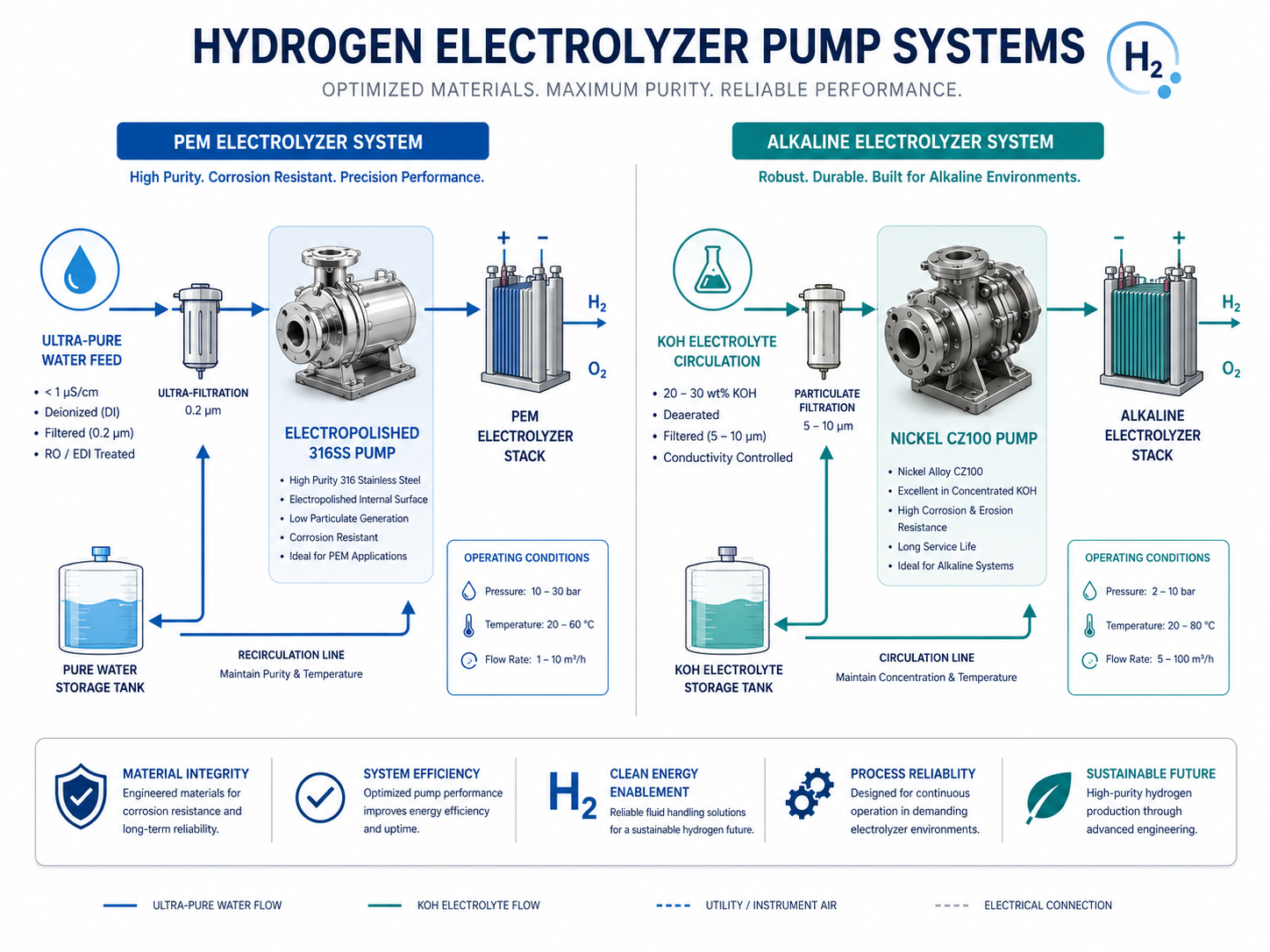
Alkaline Electrolyzers: Hot KOH — The Nickel Domain
Alkaline electrolyzers use a liquid electrolyte: 25-30% potassium hydroxide (KOH) at 160-200°F circulating through porous diaphragms between nickel electrodes. This is one of the most aggressive chemical pump services outside of concentrated acids.
Why Hot KOH Is So Aggressive
Concentrated hot caustic attacks metals through multiple mechanisms: uniform dissolution of iron and steel, caustic stress corrosion cracking (SCC) of stainless steels at welds and high-stress points, and selective leaching of alloying elements. The Pourbaix diagram for iron shows Fe → HFeO₂⁻ dissolution above pH 14 at elevated temperature — which is exactly the condition inside a KOH circulation pump.
| Material | 25-30% KOH @ 180°F | Corrosion Rate | Verdict |
|---|---|---|---|
| Cast Iron / Ductile Iron | Rapid uniform attack | >50 mpy | ❌ Never use — fails in hours to days |
| Carbon Steel (WCB) | Dissolves, H₂ evolution | 20-40 mpy | ❌ Never use |
| 316SS (CF8M) | Caustic SCC risk at welds + general corrosion >150°F | 2-10 mpy with SCC risk | ⚠️ Not recommended above 150°F or 20% concentration |
| 304SS (CF8) | Similar to 316SS but higher SCC susceptibility | 3-15 mpy with SCC risk | ❌ Worse than 316SS — do not use |
| Nickel CZ100 (ASTM A494) | Passive Ni(OH)₂ film, stable to >400°F | <1 mpy | ✅ The industry standard — all concentrations, all practical temperatures |
| Nickel 201 (wrought) | Equivalent to CZ100 | <1 mpy | ✅ Wrought alternative for small parts |
| Titanium Gr.2 | Active dissolution in hot alkaline | >100 mpy | ❌ Do not use for KOH — Titanium has zero hot alkaline resistance |
| Hastelloy C-276 | Acceptable but over-specified for pure KOH | <2 mpy | 🟡 Acceptable if already in plant inventory; 3-5× cost of Nickel CZ100 |
Nickel CZ100 — The Metallurgy Behind the Performance
Nickel CZ100 (UNS N02100) per ASTM A494 is a commercially pure nickel casting alloy (>99% Ni). Its hot caustic resistance comes from the formation of a thin, adherent nickel hydroxide (Ni(OH)₂) passive film that is thermodynamically stable across the entire pH range above 9 — and becomes more protective at higher temperatures, unlike the chromium oxide passive film on stainless steel which breaks down in hot caustic.
Key properties for pump design:
- Tensile strength: 50 ksi (345 MPa) minimum — lower than 316SS (70 ksi), requiring slightly thicker casing walls
- Yield strength: 18 ksi (125 MPa) — lower stiffness means bearing housing design must account for increased deflection
- Hardness: 80-120 BHN — significantly softer than 316SS; wear rings and shaft sleeves require hard-coating or Ni-resist inserts
- Thermal expansion: 7.2 × 10⁻⁶ in/in/°F — close to 316SS, minimizing differential expansion issues at gasket joints
For alkaline electrolyzer KOH circulation: Nickel CZ100 is mandatory. There is no cost-engineered substitute that performs reliably. The incremental material cost over 316SS for a typical 4×3-13 pump casing is approximately $12,000-18,000 — a small fraction of the cost of a KOH leak incident.
PEM vs. Alkaline — Complete Pump Material Selection Matrix
| Pump Application | PEM Electrolyzer | Alkaline Electrolyzer | ASTM Standard |
|---|---|---|---|
| Feed water pump | 316SS, electropolished ≤10 Ra | 316SS | A744 CF8M |
| Electrolyte circulation | N/A (solid PEM membrane) | Nickel CZ100 | A494 CZ100 |
| Cooling water (primary) | 316SS or coated DI | 316SS or coated DI | A744 CF8M |
| KOH makeup / dosing pump | N/A | Nickel CZ100 or Hastelloy C-276 | A494 CZ100 / A494 CW2M |
| DI water polisher | 316SS, electropolished | 316SS, electropolished | A744 CF8M |
| H₂ compressor intercooler | 316SS or Duplex SS | 316SS or Duplex SS | A890 CD4MCuN |
The Cost of Getting It Wrong
A single material specification error in an electrolyzer pump application can cascade:
- 316SS in hot KOH circulation: Caustic SCC at welds typically appears within 6-18 months of service. The crack initiates at a weld heat-affected zone, propagates intergranularly, and results in sudden loss of containment of 180°F 30% KOH — an immediate personnel safety hazard and plant shutdown event.
- Titanium in KOH service: Active dissolution begins immediately. A 4×3-13 Titanium pump casing in 30% KOH at 180°F can experience wall thickness loss exceeding 0.010 in/day. The casing can be structurally compromised in under 3 months.
- Non-electropolished 316SS in PEM UPW: Gradual ion leaching is invisible for the first 12-24 months. Then the electrolyzer stack voltage begins to drift upward — requiring more kWh per kg of H₂. Stack replacement costs $200-500/kW. For a 10 MW stack: $2-5 million replacement cost attributable to a $15,000 pump specification shortcut.
⚠️ Documentation for Green Hydrogen Project Finance
Green hydrogen projects undergo rigorous due diligence for project finance (debt and equity). Every pump must ship with: full Material Test Reports (MTRs) with heat number traceability per EN 10204 Type 3.1 | Positive Material Identification (PMI) verification on each casting | surface finish measurement reports (profilometer traces) | hydrostatic test certificates (1.5× MAWP) | material compliance certification to applicable ASTM specifications.
Nickel CZ100 material certified to ASTM A494/A494M. Titanium certified to ASTM B367 Gr. C-2. 316SS certified to ASTM A744/A744M Gr. CF8M. All documentation is serial-number-traceable from the pump nameplate to the individual casting heat lot. This is the documentation standard that project finance lenders require.
Mechanical Seal & Sealing Systems
PEM UPW Service
Specify API 682 cartridge seals with the following materials:
- Seal faces: Silicon carbide vs. silicon carbide (SiC/SiC) — harder than carbon or tungsten carbide faces, resists any incidental particulates
- Elastomers: PTFE or specially cleaned/processed FKM (low extractables grade) — standard FKM grades leach trace organics
- Metal parts: 316SS only — no copper alloys, no free-machining grades
- Seal flush: API Plan 11 (product recirculation) is typically adequate; Plan 32 (external clean flush) adds margin for critical stacks
Alkaline KOH Service
Hot concentrated KOH attacks standard seal elastomers aggressively:
- Elastomers: PTFE only. FKM (Viton®), EPDM, and NBR are all attacked by hot caustic. PTFE is the only reliable elastomer for KOH above 150°F
- Seal faces: SiC/SiC or, for high-solids KOH with carbonate precipitation, consider hard-faced TC/TC
- Springs & metal parts: Nickel alloy (Hastelloy C-276 or Alloy 625) — 316SS springs will fail from caustic SCC
- Seal flush: API Plan 32 (external flush) with clean water or dilute KOH to prevent KOH crystal formation at the seal faces during standby
Surface Finish & Cleanliness Specifications
| Requirement | PEM UPW Pumps | Alkaline KOH Pumps |
|---|---|---|
| Wetted surface finish | ≤10 Ra μin (0.25 μm), electropolished | 63-125 Ra μin (standard machined) |
| Electropolish standard | ASTM B912, passivate per ASTM A967 | Not required |
| Surface inspection | Profilometer trace on each casting | Visual inspection only |
| Cleanliness | Particle-free assembly, oxygen-cleaned for O₂-side | Standard industrial clean |
| Packaging | Double-bagged with desiccant, flange protectors | Standard export packaging |
Scale-Up Considerations: Pilot to GW-Scale
Green hydrogen projects typically progress through distinct phases. Pump specifications should evolve with each phase:
Pilot Phase (1-10 MW)
Focus on material correctness and documentation. The pump cost is negligible compared to stack cost. Over-specify rather than risk contamination. Electropolished 316SS for all UPW services. Nickel CZ100 for all KOH services. Build the documentation package that will be referenced during scale-up engineering.
Commercial Phase (100-500 MW)
Optimize for lifecycle cost. Standardize pump models across the plant for maintainability. Evaluate Titanium vs. electropolished 316SS for UPW based on stack manufacturer warranty requirements. Negotiate multi-unit pricing. Request full performance test curves for critical pumps.
GW-Scale Phase (1 GW+)
Supply chain resilience becomes paramount. Single-source pump supply for 1 GW of electrolyzer capacity represents unacceptable project risk. Qualify dual sources at the pilot phase. Maintain semi-finished inventory for critical Nickel CZ100 components. Negotiate framework agreements with guaranteed lead times and price ceilings.
🔗 Related Reading
📋 Request a Quote — Response Within 24 Hours
Our engineering team reviews every inquiry and provides a detailed quote with material compatibility confirmation and documentation package details.
Aviso de Privacidad Simplificado: JINAN YINGSIMAN MACHINERY CO., LTD., con domicilio en Room 6-A10, Building F, Golden Times Square, No. 9999 Jingshi Road, Lixia District, Jinan City, Shandong Province, China, es responsable del tratamiento de los datos que proporcione. Podemos recabar datos de contacto, empresa, proyecto, equipo y archivos técnicos para atender su solicitud, revisar compatibilidad o selección, preparar una cotización y proporcionar seguimiento técnico y comercial. Puede solicitar la limitación del uso o divulgación de sus datos y ejercer sus derechos ARCO escribiendo a [email protected]. Consulte el Aviso de Privacidad integral.