
⚡ Executive Summary: CD4MCuN costs only 50% more than 316SS but delivers 2.4× higher yield strength, 2× harder surfaces, and virtual immunity to chloride SCC. The result: 3-5× longer service life in abrasive slurry and chloride services. This guide provides the metallurgical rationale, real-world case data, and a step-by-step ROI model to justify the upgrade.
316SS: The Default — But Not Right for Everything
Walk through any North American chemical plant. The majority of ANSI pumps are 316SS (CF8M) — familiar, widely available, adequate for general chemical service. Maintenance teams know it. Warehouses stock it. Engineering specs default to it.
But for abrasive slurries and chloride-laden fluids, 316SS is quietly failing years before its expected service life — and the failure is not dramatic. It is gradual. Until it is not.
There is a better material that costs just 50% more and lasts 3-5× longer. This article explains why it works, where it works, and how to build the financial case for upgrading your fleet.
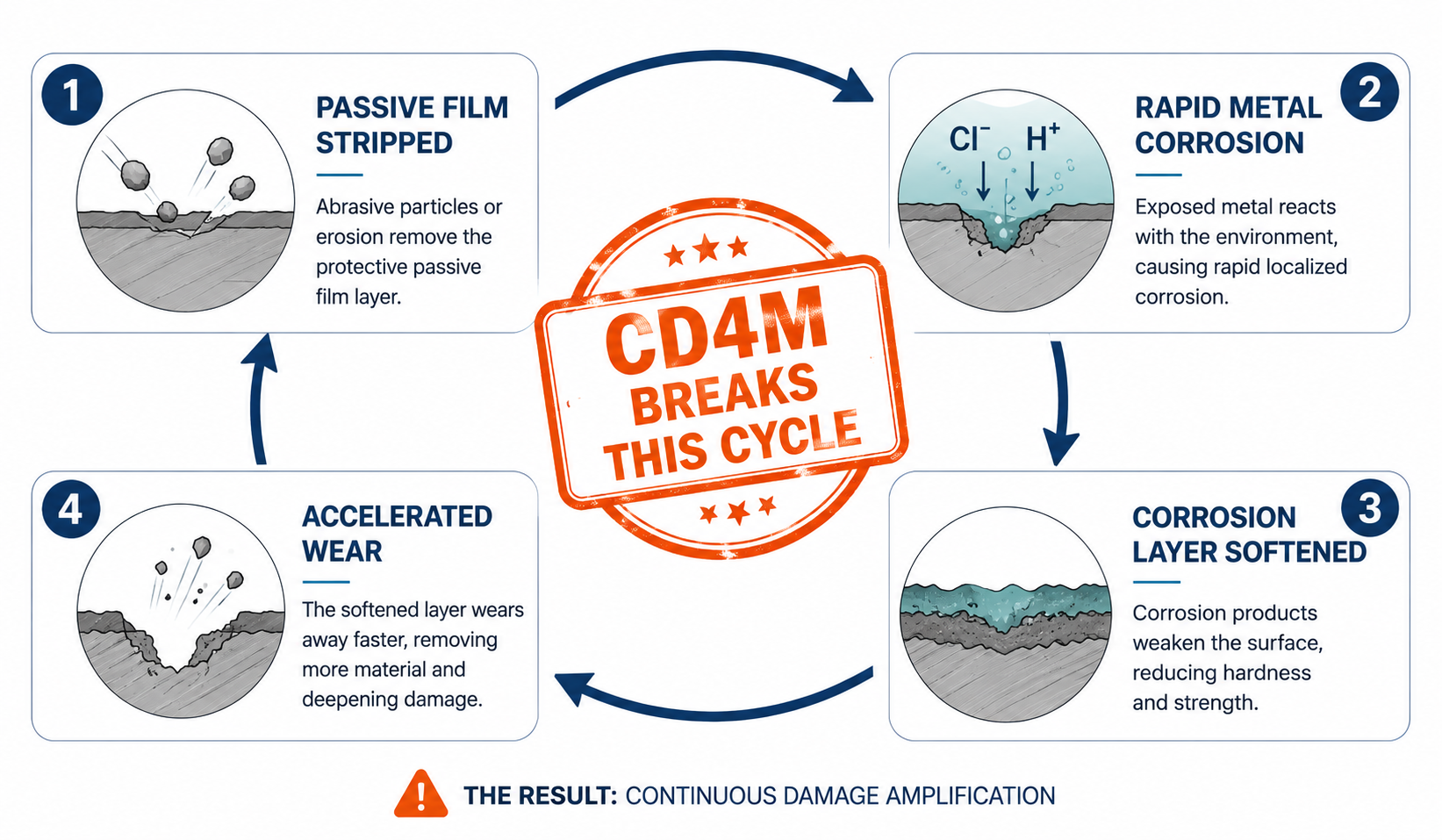
The Destruction Cycle: Why 316SS Fails in Slurries
The failure of 316SS in abrasive-corrosive service is not one mechanism — it is a destructive synergy of 4 stages repeating in a self-reinforcing loop:
- Passive oxide layer is eroded away — abrasive particles (sand, catalyst fines, gypsum crystals, metal oxides) strip the nanometer-thick chromium oxide (Cr₂O₃) passive film. Without this film, 316SS is just mild steel with slightly better chemistry. Source: NACE Corrosion 2024 Paper 2024-13578; ASM Handbook Vol. 13B [1]
- Bare metal corrodes 10-100× faster — without passive protection, even mild chemicals become aggressive. The corrosion rate jumps from <0.1 mpy (passive) to 5-20 mpy (active) depending on pH and chloride concentration. [2]
- Corroded surface softens — corrosion products and selective leaching (especially chromium depletion) create a mechanically weaker surface layer, 20-40% softer than the base metal. [3]
- Abrasion removes softened layer faster — the weakened surface erodes at 3-5× the rate of sound metal, exposing fresh reactive metal, accelerating back to Step 1.
CD4MCuN breaks this cycle at every stage: higher hardness resists initial abrasion, higher yield strength resists particle impact erosion, and superior chloride pitting resistance (PREN 34-38 vs. 24-28) means even when the passive layer is breached, the underlying metal corrodes far slower.
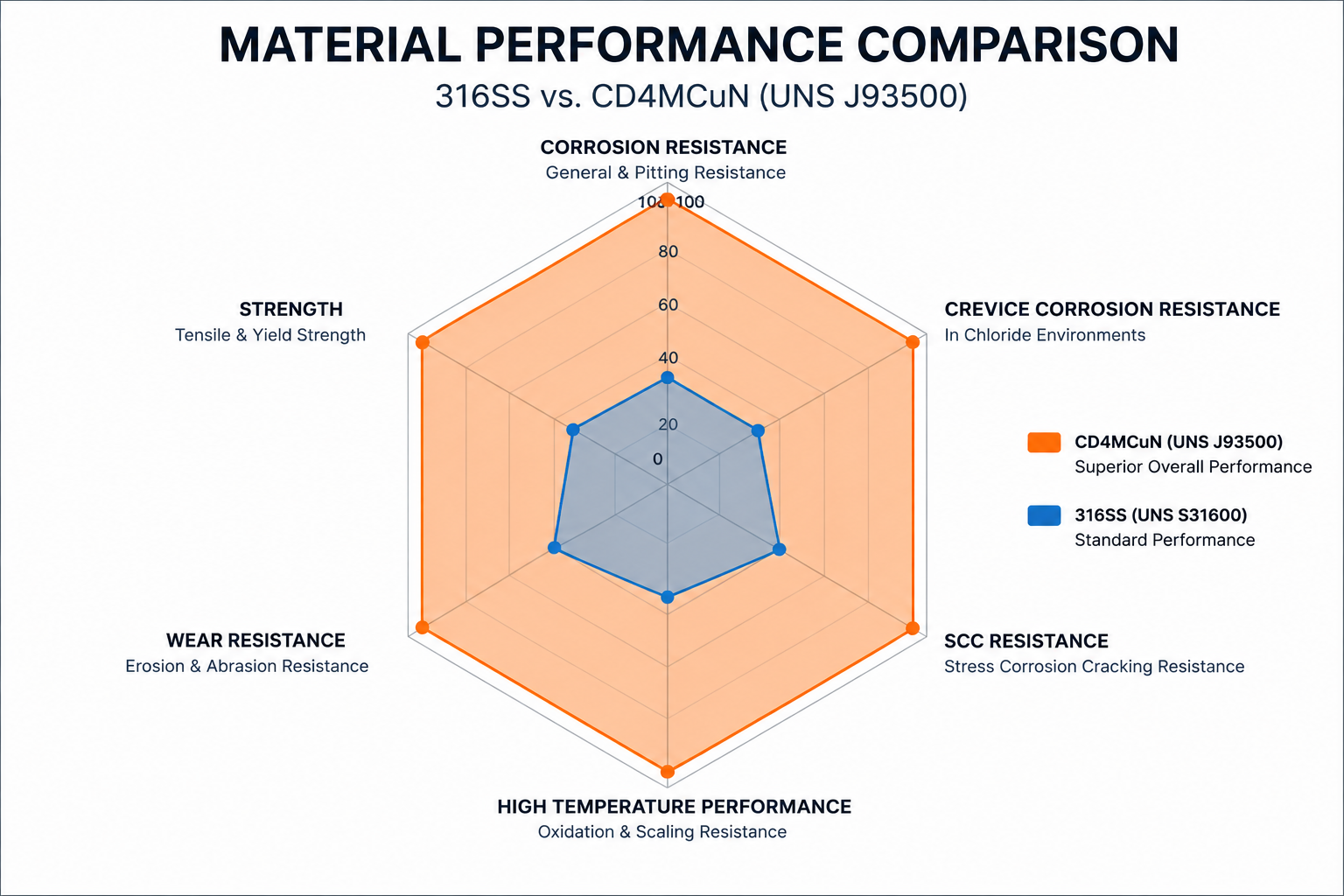
316SS vs. CD4MCuN — Head-to-Head Technical Comparison
| Property | 316SS (ASTM A744 CF8M) | CD4MCuN (ASTM A890 Gr.1B) | CD4M Advantage |
|---|---|---|---|
| Tensile Strength | 70 ksi (485 MPa) | 100 ksi (690 MPa) | +43% |
| Yield Strength | 30 ksi (205 MPa) | 70 ksi (485 MPa) | +136% (2.4×) |
| Hardness (BHN) | 140-180 | 255-290 | ~2× harder |
| PREN (Pitting Resistance) | 24-28 | 34-38 | +40% |
| Chloride SCC Above 140°F | Susceptible — rapid failure | Virtually immune | Categorical difference |
| Slurry Erosion Resistance | Baseline | 2-3× better | Harder + work hardening |
| Corrosion Fatigue Limit | 15-20 ksi | 30-35 ksi | ~2× in Cl⁻ environments |
| Cost vs. 316SS | 1.0× | 1.5× | Modest premium for dramatic gain |
The Metallurgy Behind the Numbers
CD4MCuN (UNS J93372) is a duplex stainless steel with a carefully balanced ferrite-austenite microstructure (target 40-60% ferrite). The key alloying elements work together:
- Chromium (24.5-26.5%): Primary passive film former. 6-8% higher than 316SS (16-18% Cr) — this is the single biggest factor in corrosion resistance improvement
- Nickel (4.7-6.0%): Austenite stabilizer. Balances the duplex structure. Lower than 316SS (10-14% Ni) because the higher N content partially substitutes for Ni
- Molybdenum (1.7-2.3%): Pitting resistance in chloride environments. Roughly equivalent to 316SS (2-3% Mo) but more effective due to partitioning into the ferrite phase
- Copper (2.7-3.3%): The differentiator. Copper provides additional corrosion resistance in reducing acids (H₂SO₄) and enhances the passive film stability
- Nitrogen (0.10-0.25%): Strengthens the austenite phase, enhances pitting resistance (raises PREN), and stabilizes the duplex structure
Real-World Case: Gulf Coast Chemical Plant Saves $380K in 3 Years
The situation (2023): A Texas Gulf Coast EDC/VCM plant operated 18 × 316SS ANSI pumps in a cooling tower blowdown service — concentrated chlorides at 150-170°F with suspended solids. The 316SS pumps required wet-end rebuilds every 18-22 months due to chloride pitting and crevice corrosion at gasket surfaces. Annual rebuild cost: $127,000 in parts + $54,000 in labor = $181,000/year across the fleet.
The pilot (January 2024): Upgraded 3 pumps to CD4MCuN wet ends during a scheduled turnaround. Incremental material cost: $3,850/pump ($7,700 total) over 316SS replacement cost.
3-Year Results (through January 2027):
| Metric | 316SS Fleet (15 pumps) | CD4MCuN Pilot (3 pumps) |
|---|---|---|
| Rebuilds per pump per 3 years | 1.8 (average) | 0 (zero) |
| Unplanned downtime events | 4 | 0 |
| 3-Year parts + labor cost | $543,000 | $0 (beyond initial install) |
| Casing wall thickness loss | 0.015-0.030 in | <0.005 in (negligible) |
| Impeller erosion | Visible grooving, 5-8% mass loss | No measurable loss |
Financial impact: $380,000 saved in avoided rebuilds and downtime over 3 years on just 3 pilot pumps. The plant is now systematically upgrading the remaining 15 pumps to CD4MCuN during planned turnarounds — at zero additional downtime cost.
📥 Want the full case study data? Download our CD4MCuN ROI calculator with this plant’s actual 3-year cost comparison data. Jump to download →
Where CD4MCuN Dominates 316SS
| Application | Failure Mechanism (316SS) | 316SS Typical Life | CD4M Expected Life | Life Multiplier |
|---|---|---|---|---|
| FGD absorber recycle | Limestone abrasion + coal chlorides | 2-3 years | 6-10 years | 3-4× |
| Wet phosphoric acid | Gypsum solids + fluoride at 180°F | 1-2 years | 4-6 years | 3-4× |
| Cooling tower blowdown | Cl⁻ SCC above 140°F | <2 years | 10+ years | 5×+ |
| Produced water injection | High Cl⁻ + entrained sand | Rapid pitting, <1 year | 5-8 years | 5-8× |
| Mineral processing slurry | Abrasion + acidic process water | 1-3 years | 4-8 years | 3-4× |
| Lithium battery black mass | Abrasive metal oxides + hot H₂SO₄ | 6-12 months | 3-5 years | 4-6× |
When NOT to Upgrade to CD4MCuN
CD4MCuN is superior to 316SS in most aggressive services — but it is not universally the right choice:
- Strong oxidizing acids (HNO₃ >20%): The high ferrite content in CD4MCuN has lower resistance to strongly oxidizing environments than fully austenitic 316SS. Stick with 316SS or upgrade to Alloy 20. [4]
- Non-abrasive, non-chloride services: If your 316SS pumps consistently achieve 5+ year service life without corrosion or erosion issues, the CD4MCuN premium adds cost without meaningful benefit. Use the audit checklist below to identify true upgrade candidates.
- Small frame sizes with low utilization: For a 1×1.5-6 pump operating 500 hours/year in mild service, the absolute dollar savings may not justify the material premium.
- Customer-specified materials: Some end-user specifications or licensor requirements mandate specific materials — verify before substituting.
⚠️ CD4MCuN Quality Verification — What Your MTR Must Show
Every CD4MCuN component ships with: OES chemical analysis verifying Cr 24.5-26.5%, Ni 4.7-6.0%, Mo 1.7-2.3%, Cu 2.7-3.3%, N 0.10-0.25% | Mechanical properties (100 ksi UTS, 70 ksi yield, 255-290 BHN, >25% elongation) | Ferrite content (target 40-60% per ASTM E562 point count or magnetic method) | Charpy impact testing at -50°F per ASTM A923 Method B — verifies freedom from deleterious intermetallic phases | Corrosion test per ASTM A923 Method C (ferric chloride) — confirms corrosion resistance of the duplex structure | Full heat number traceability from foundry melt to finished machined part.
4-Step Upgrade Implementation Plan
Step 1: Audit Your Fleet for Upgrade Candidates
Flag any 316SS pump where: rebuild frequency exceeds once per 3 years, failure mechanism involves corrosion or erosion (not just mechanical seal wear), or unplanned downtime carries production consequences exceeding $50,000/day. Prioritize pumps where failure = production loss or safety risk.
Step 2: Run a Controlled Pilot on 2-3 Pumps
Select pumps in the most aggressive service first. On the next scheduled rebuild, replace 316SS wet-end components (casing, impeller, wear rings, shaft sleeve) with CD4MCuN. Take baseline CMM measurements and close-up photographs of the 316SS components being removed — this documentation is essential for the ROI case.
Step 3: Inspect and Document at 6-Month Intervals
At each scheduled shutdown, pull the pilot pump and inspect: wall thickness (ultrasonic), impeller vane condition, wear ring clearances, surface condition (visual + borescope). Compare to the baseline. The data from these inspections builds the financial case for fleet-wide rollout.
Step 4: Roll Out Based on Data — Not Opinion
If the pilot validates expected life improvement (3-5×), systematically upgrade the fleet during planned turnarounds. The incremental cost of CD4MCuN over 316SS wet ends is absorbed within 1-2 avoided rebuild cycles. After that, every cycle is net savings.
CD4MCuN ROI Calculator — Quick Reference
| Fleet Size | 316SS Annual Rebuild Cost | CD4MCuN Upgrade Cost | Payback Period | 5-Year Net Savings |
|---|---|---|---|---|
| 5 pumps | $45,000 | $12,500 (one-time) | 3.3 months | $212,500 |
| 15 pumps | $135,000 | $37,500 (one-time) | 3.3 months | $637,500 |
| 50 pumps | $450,000 | $125,000 (one-time) | 3.3 months | $2,125,000 |
Assumptions: 316SS rebuild every 18 months average; CD4MCuN extends to 5+ years; rebuild cost includes parts ($8,500 avg) + labor ($2,000) per pump; excludes downtime cost (adds $15-50K/day per pump). Your actual results depend on specific service conditions.
📥 Download: CD4MCuN ROI Calculator Spreadsheet
Enter your fleet data — pump count, current rebuild frequency, parts and labor costs — and get a customized 5-year TCO comparison. Includes the Gulf Coast case study data.
Aviso de Privacidad Simplificado: JINAN YINGSIMAN MACHINERY CO., LTD., con domicilio en Room 6-A10, Building F, Golden Times Square, No. 9999 Jingshi Road, Lixia District, Jinan City, Shandong Province, China, es responsable del tratamiento de los datos que proporcione. Podemos recabar datos de contacto, empresa, proyecto, equipo y archivos técnicos para atender su solicitud, revisar compatibilidad o selección, preparar una cotización y proporcionar seguimiento técnico y comercial. Puede solicitar la limitación del uso o divulgación de sus datos y ejercer sus derechos ARCO escribiendo a [email protected]. Consulte el Aviso de Privacidad integral.
🔗 Related Reading
📋 Request a CD4MCuN Upgrade Quote — Response Within 24 Hours
Tell us about your pump fleet and service conditions. We will return a dimensional compatibility confirmation, firm pricing, and a customized 5-year TCO projection.
Aviso de Privacidad Simplificado: JINAN YINGSIMAN MACHINERY CO., LTD., con domicilio en Room 6-A10, Building F, Golden Times Square, No. 9999 Jingshi Road, Lixia District, Jinan City, Shandong Province, China, es responsable del tratamiento de los datos que proporcione. Podemos recabar datos de contacto, empresa, proyecto, equipo y archivos técnicos para atender su solicitud, revisar compatibilidad o selección, preparar una cotización y proporcionar seguimiento técnico y comercial. Puede solicitar la limitación del uso o divulgación de sus datos y ejercer sus derechos ARCO escribiendo a [email protected]. Consulte el Aviso de Privacidad integral.